Passing Mark, organization tools like Categories and Collections, Metadata and more are all available for viewing and updating on the Project Properties panel

Every Project you create has a set of Properties, some of which are set by your dominKnow | ONE site but most of which you can edit to meet your needs.

You can open the Project Properties panel several ways.

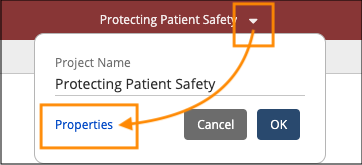
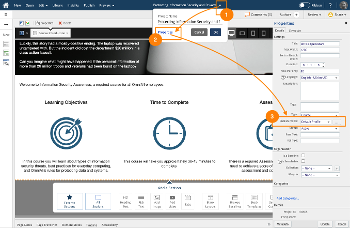
One easy way is to select the Project name at the top of the interface then select Properties on the panel that opens.

You can also open the Project Properties panel by:

  • Double-clicking the Project name on the Project Outline to the left of the Stage
  • Selecting the Project icon in the breadcrumb above the Stage then selecting Properties
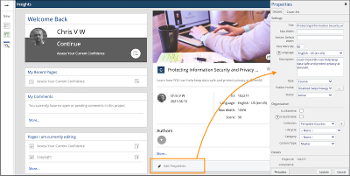
  • Selecting Edit Properties on the Insights panel

The Project Properties panel will open to the right of the Stage.

Here's a section-by-section run-down of the various properties available on the panel.

It has three tabs across the top:

  • Details
  • Cover Art
  • Assignments

At the bottom of the panel there are three buttons:

  • Metadata
  • Update
  • Cancel


Metadata opens the Metatada panel where you can add and edit metadata for the project such as copyright statements, disclaimers and more. See below for more details.

When you make any changes to the Project Properties you need to use the Update button at the bottom of the panel to save your changes.

The Cancel button will cancel any changes you have made and close the Project Properties panel.

Details Tab

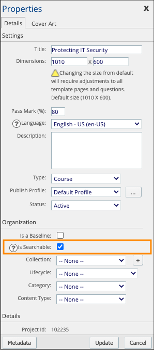
The Details Tab has sections for:

  • Settings
  • Organization
  • Categories
  • Details

Settings
The top section of the Details tab is the Settings section.

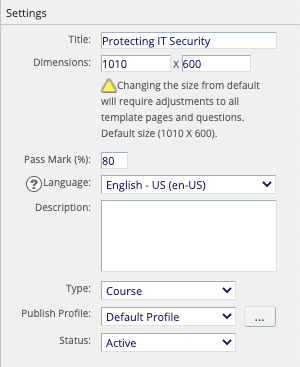
The Settings section has fields for:

  • Title: This is the name you gave your course upon creation.
  • Dimensions (in Claro), Max Width (in Flow):
    • In Claro projects the page dimensions will be displayed automatically. The default width is 1010x600 but you can set other dimensions if you wish.
    • In Flow projects the maximum width value is set at 1200 pixels by default. You can set a different width or leave this option blank if you want the project content to always fill the display width for all viewport sizes.
  • Section Default Width (Flow only): Add a value if you wish to set your Sections to have a width different than the Max Width setting.
  • Duration: Allows you to indicate an expected length of learning time for the Project. This is an information-only setting and is not passed to the LMS as part of a SCORM or other learning standards package.
  • Pass Mark: Input the score required to pass the project. When you make a new Project, the Pass Mark is set to 80% by default.
  • Language: Choose from the list of available languages.
  • Description: Add a detailed description of the material for the learner. The Description field text is included in packages published to SCORM or other learning standards and is passed to the LMS.
  • Tags: Add keywords to help when searching for the Project in the Browse Panel.
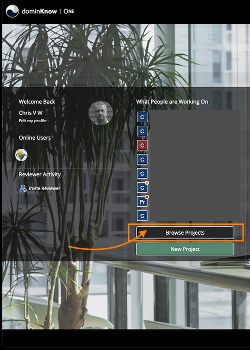
  • Type: Select the type of learning such as course, activity, job aid, infographic, etc. The Project icon will display the abbreviation of the type of learning you select, for example on the Browse Projects panel and other places. The Type can be used as one of the filters on the Browse panel as well as in Reports.
    • NOTE: The Assessment type is the only option that changes the behaviour of the Project. If the Project is set to Assessment, it will only display test questions to the learner. Learning content pages will not be shown.
  • Publish Profile: Choose from available options or create your own customized profile by clicking the button.
  • Status: Select a status for the course from Active, Disabled, Offline/Retired, Locked/Read Only. Statuses other than Active will be denoted on the course icon by a colored dot.
  • Pass Text: Allows you to set custom text to show to the learner instead of the default Pass Text.
  • Fail Text: Allows you to set custom text to show to the learner instead of the default Fail Text.

Organization

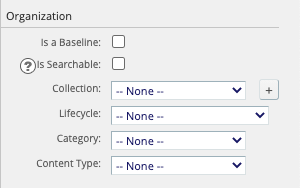
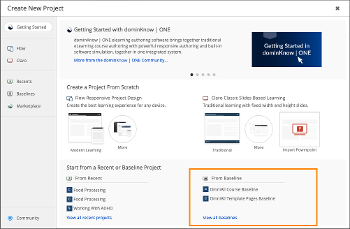
  • Is a Baseline: Select to set the Project as a Baseline Project for your organization. NOTE: Only Administrators can set this.
  • Is Searchable: An Administrator can select the Is Searchable checkbox to allow the Project's content to be searchable even if an Author has not been assigned editing permission to the Project. (Authors can not select this option. If an Author creates a Project which should be searchable for everyone then an Admin user will have to edit the Project Properties.)
  • Collection: Choose a collection from the list. Administrators will also see a ... button to create new Collections.
  • Lifecycle: Select a lifecycle from the available options.

Categories
Selecting Add Categories... opens a panel where you can select categories to which you can associate the Project.

Details
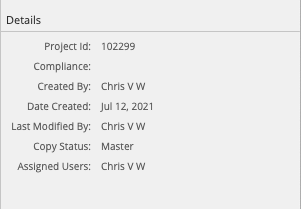
The properties in the Details section are created and tracked by the dominKnow | ONE site automatically. They can not be edited on the Properties panel, except for the Compliance text which can be edited from the Metadata button.
They include:

  • Project ID: Unique project identification number which is automatically assigned upon project creation.
  • Compliance: Displays any compliance text that is inputted via Metadata.
  • Created By: Displays the name of the user who originally created the project.
  • Date Created: Displays the date the project was originally created.
  • Last Modified By: Displays the name of the user who last edited the project.
  • Copy Status: Indicates if the project is a Master or is a Duplicate or Shared copy of another project
    • Parent: If the project is not a Master, the Parent field will be shown and will display the name of the project from which it was copied.

Cover Art Tab

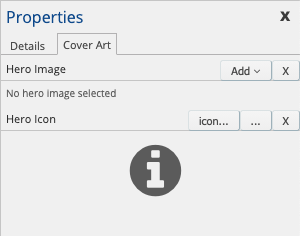
The Cover Art tab has options for:

  • Title Styles
  • Hero Image
  • Hero Icon

These are used by Themes.

Note: Not all Themes use all of these features.

Title Styles

When you add text to the Project title and Description fields on the Details tab, the text is plain text with no formatting available.

The Cover Art tab's Title and Subtitle fields let you add formatting.

For example, in the Title field you can set some text in italics, and it will be shown in italics on the top navigation bar in a theme set to display the Project Title.

The Subtitle text field can be used to provide formatted display text for the project Description field. The Tutorial theme, for example, displays the Project description on its home menu page. If you only have text in the Description field, the text will display as plain text. Using the Subtitle text field on the Cover Art tab you can add formatting such as bold, italics, etc. to be shown on the Tutorial theme's home menu page.

Note: Text added to the Cover Art tab's Title and Subtitle text fields are only used by Themes instead of the Title and Description fields on the Details tab. They do not replace the text in these fields within displays in dominKnow | ONE interfaces. So it is a best practice to have Description text on the Details tab as well as Subtitle text on the Cover Art tab.

The project's Hero image is used by the Storyview and Knowledge Base theme on their home (menu) pages.

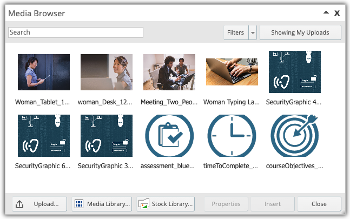
You can use the Add drop down to set a Hero image.

The X button removes the hero image.

Note: You can also add a Hero Image on the Project's Insights panel.

Hero Icon

The Hero Icon is available for use in possible future features. It is not currently used by any themes.

The Icon button lets you add an icon from dominKnow | ONE's icon library.

The ... button lets you add an image file as the icon.

The X button removes the hero icon.

Assignments Tab

The Assignments tab displays Authors and Reviewers who have been assigned to the Project.

You can use the + Assign Authors or + Assign Reviewers buttons to add more assigned Authors or Reviewers.

Selecting the avatar for an Author or Reviewer displays their user card, which in this case displays how they have been assigned to the Project which can include:

  • Assigned directly to it
  • Assigned to a Collection which includes the Project
  • Assigned to it as part of a Team assigned directly to the Project
  • Assigned to it as part of a Team assigned to a Collection which includes the Project

You can use the Edit Assignment options (in this example, Edit Collection Assignments) to change the assignment.

Metadata

At the bottom of the Project Properties panel is a button, Metadata.

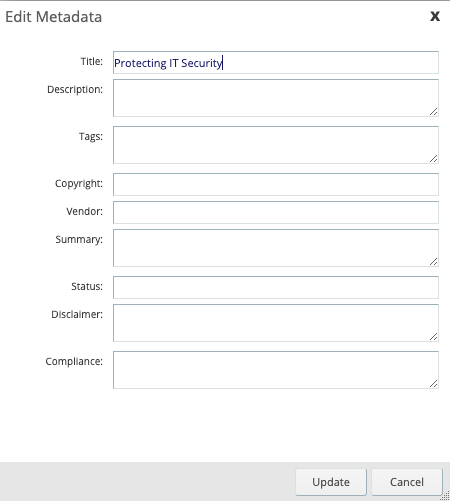
Selecting it opens the Edit Metadata panel.

The Edit Metadata panel lists out the Project's metadata fields.

Some of these fields are available on the Project Properties's Details tab:

  • Title
  • Description
  • Tags

Several of the other fields are available for use as system variables within projects:

  • Copyright
  • Summary
  • Disclaimer
  • Compliance

This means you can pull the information in these fields into text elements on project pages.

For example, you can add a text field to the bottom of pages and display the system variable for Copyright instead of entering the copyright statement into each text element individually. When the copyright statement is updated on the Edit Metadata panel, it will automatically be updated in all the on-page text elements at once.

Some of the fields are information-only:

  • Vendor
  • Status

Updating Any Changes

When you make any changes to the Project Properties, use the Update button at the bottom of the Project Properties to apply the changes:


  0     0

Similar Projects

Questions  ( 0 )