A text element's Style tab options and the Type options on the Format tab are all determined by Theme settings.
In addition to these Theme-design settings you can also apply inline styling to text within an element.

A text element's Style tab options and the Type options on the Format tab are all determined by Theme settings.
In addition to these Theme-design settings you can also apply inline styling to text within an element.
NOTE: Using inline styling on text overrides the style settings of the Theme you are using. So in general, we recommend using caution when applying Inline styling options to text.
For example, inline styling can apply a color to a word for emphasis. But if you change the color for the entire text element using the options on the Style tab, the inline color you set for that word will not change. And that inline color may not work with the newly-chosen Theme color.
Similarly, you can use the Font Size drop down to assign a size to a Rich Text element. But it’s more effective to use the Values available on the Format context tab to set font size. If the Theme’s default font size is changed, the Text Values are designed to adapt to that change. The Values are set as ratios based on the Theme’s default value, so they are calculated automatically.
So we suggest using inline text styling for limited use cases, such as emphasis.
When you are editing a Text Element there are two places where you can apply inline text styling, the inline styling mini-toolbar and the Font and Paragraph sections of the Format tab.
When you are working in a Text element, you’ll see the inline styling mini-toolbar (Note: This is not available in a Plain Text element):
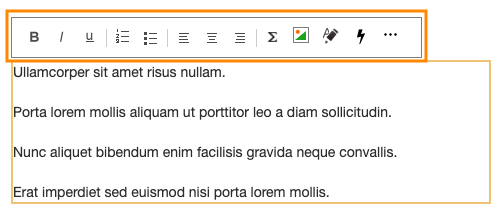
The mini-toolbar provides quick access to the most-commonly used inline text styling options:
It also provides access to add mathematical formulas, add an image inline within your text element, access to Project Styles as well as access to many other text tools under the three-dot menu.
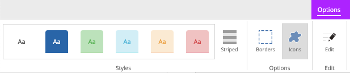
There are more inline text styling options available on the Options Tab of the Ribbon, in the Font and Paragraph sections:

In the Font section you can:
In the Paragraph section you can:
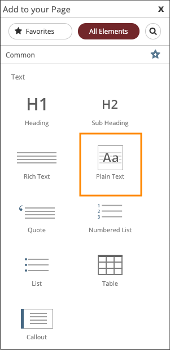
Add fun special effects to text using Plain Text Elements
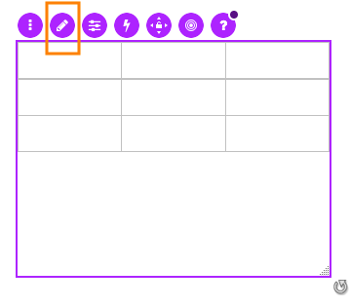
Tables are a great way to organize data or information, especially for comparison purposes.
List elements offer more visual design and animation options than simple bullet text lists
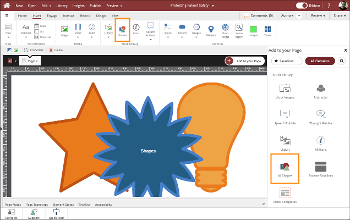
Improve learning and understanding with Shapes as design and decorative details
How to change size and color as well as work with features like Glossary definitions, Tooltips and more
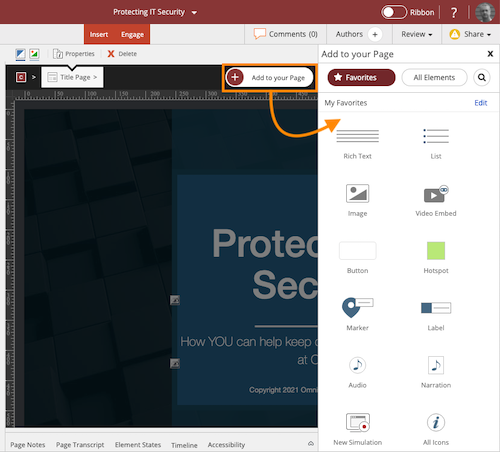
Quickly and easily add Elements to a Claro page or Sections to a Flow page
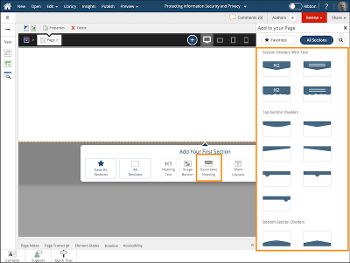
Tips for controlling the display and design of Sections with Dividers
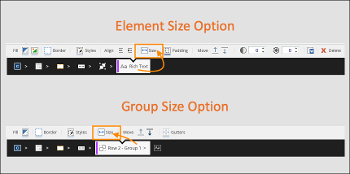
Understanding the Size controls can help you customize responsive behavior and layout designs
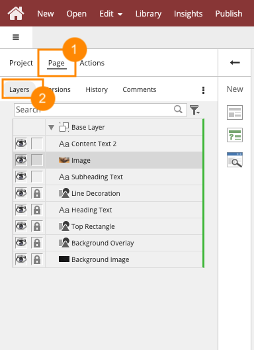
Use Layers to group elements together on a Claro page for organizing the page and for targeting with actions
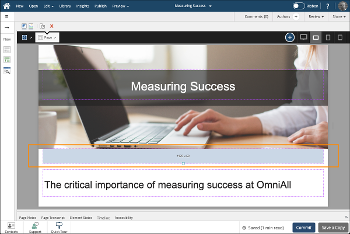
A simple design element to control vertical spacing

Comments ( 0 )
Sign in to join the discussion.